You’re likely a British citizen by descent if a British parent passed citizenship to you automatically at birth under Gov, rather than through UK residence. That status usually means you cannot pass citizenship to a child born outside the UK, under the British Nationality Act 1981. Whether you got it automatically or need to register depends heavily on your birth date and which parent carried it. Check the eligibility and registration sections below against your own family’s dates before assuming either way.
TL;DR:
- If your parent is British by descent, you generally cannot automatically pass citizenship to children born outside the UK unless your parent held citizenship “otherwise than by descent.”
- Registering through historic pathways like section 4C or forms UKF and UKM is often necessary if your claim involves older laws or pre-1983 maternal-line cases, requiring careful evidence-gathering.
- Using the correct registration form and evidence set is essential; incorrect filing causes significant delays due to processing backlogs and requests for additional proof.
- Confirming your parent’s precise acquisition route and evidence beforehand shortens the process, especially in complex, cross-generational or Crown service cases.
Immigrationassistance Prepare Your Citizenship Evidence Immigrationassistance guides British citizenship applications with thorough evidence preparation and support from consultation through timely updates.Visit Immigrationassistance
Table of Contents
- What makes you a British citizen by descent?
- Which registration route applies to your family?
- What documents do you actually need?
- How do you actually submit the application?
- The traps that catch even confident applicants
- How Immigrationassistance approaches descent claims
- How do you prove citizenship by descent for a passport?
- What changes once you live outside the UK?
- Why the “just apply” advice misses the point
- Get help preparing your citizenship-by-descent application
- Sources
- FAQ
What makes you a British citizen by descent?
The rules split sharply around two key dates in the early 2000s and 1980s. Get your birth date and your parents’ circumstances lined up against these, and most people can work out their own status within a few minutes.
If you were born outside the UK after the mid-2000s, you’re automatically a British citizen when either parent was a British citizen who could pass on citizenship at the time of your birth. That last clause matters more than most guides admit. A parent who is themselves “British citizen by descent” generally cannot transmit citizenship to a child born abroad, so the test isn’t just “was my parent British?” It’s “was my parent British in a way that transmits?” GOV.UK’s caseworker guidance draws this line explicitly: once a parent’s own status is classified as by descent rather than otherwise than by descent, they normally cannot pass nationality to children born overseas.
“Otherwise than by descent” covers people born in the UK, people naturalized in the UK, and a handful of other categories tied to actual UK residence or Crown service. “By descent” covers people who got citizenship through a parent while being born outside the UK. The distinction sounds bureaucratic until you realize it decides whether your children, if born abroad, will have any claim at all.
Births before January 1, 1983, add another layer, because the law before that date only recognized the father’s nationality for automatic transmission. Children born abroad to British mothers before 1983 typically got nothing automatically, no matter how British their mother was. This wasn’t fixed retroactively. It was fixed through registration routes that Parliament added later, which is why so many people alive today with a British grandmother or mother from that era assume they’re citizens and then discover they need to apply rather than simply prove.
Two quick examples show how differently this can play out:
- A child born in Canada in 2010 to a mother who was born in Manchester (so “otherwise than by descent”) is automatically a British citizen by descent from birth. No application needed, just proof.
- A child born in Australia in 1975 to a British mother, with no British father, was not automatically a citizen at birth under the old rules and instead has to register under a specific historic route, discussed next, to acquire British citizenship by descent now.
A grandchild of a British citizen sits in a different category entirely, and this is where most confusion starts. If your parent was themselves a citizen “by descent” through your grandparent, that chain typically stops at your parent’s generation for automatic purposes. You may still have a route in through registration, but it isn’t automatic, and it isn’t guaranteed. That’s covered fully in the registration section.
Which registration route applies to your family?
If your case doesn’t fit the automatic rules, you’re looking at registration under the British Nationality Act 1981, and the route depends entirely on which historic gap in the law affected your family.
-
Section 4C covers people born before 1983 to a British mother who could not pass on citizenship automatically because of the old paternal-line rule. Registering under 4C gives British citizenship by descent, retroactively closing a gap that existed for decades. This is the route most Americans, Canadians, and Australians with a British grandmother end up researching once they realize their mother’s citizenship never transmitted automatically.
-
Sections 4F through 4I cover a narrower set of historic scenarios, mainly people born to unmarried parents where the father was British or settled but the parents’ marital status blocked automatic transmission under older law. These sections exist because the law used to treat legitimacy as a gatekeeper for nationality, and Parliament built specific fixes rather than a blanket retroactive change. GOV.UK’s guidance on children of British parents walks through which sub-section applies based on the parents’ marital status and the child’s birth date.
-
Form UKF is what you use when the case involves parents who were not married to each other, and it comes with its own evidence list, covering proof of paternity, the father’s nationality status, and dates of birth for everyone involved. The Form UKF guidance is explicit that the full fee is not returned if the application fails, which makes getting the evidence right before you submit a genuinely financial concern, not just a bureaucratic one.
-
Form UKM is the form for the classic pre1983 maternal-line case: born before January 1983 to a British mother. It asks for a different evidence set focused on the mother’s own citizenship status and the marriage (or absence of one) between the parents.
The grandparent route deserves a blunt warning here: there is no standard “citizenship by grandparent” registration category. If your parent didn’t acquire and hold transmittable citizenship, you generally need your parent to register first (if they’re eligible), and only then can your own claim, if any, be assessed. Skipping a generation rarely works, no matter how strong the family story is.
What documents do you actually need?
The baseline document set looks like this:
- Your own full birth certificate (not the short version, which omits parents’ details).
- Your British parent’s full birth certificate, or their naturalization or registration certificate if they weren’t born in the UK.
- Your grandparent’s birth or naturalization certificate, if the claim runs through a grandparent’s status affecting your parent.
- Your parents’ marriage certificate, where marital status affects which section or form applies.
- Any name-change documents (deed poll, marriage certificate for a name change) linking records that don’t match exactly.
A UK birth certificate for a grandparent is often not enough on its own in a multi-generation chain, because it proves birth, not the specific legal category their citizenship fell into at the relevant time. Home Office caseworkers need to trace how each person in the chain acquired citizenship, whether by UK birth, registration, or naturalization, because that acquisition route is what controls whether it transmitted onward. This single point trips up more applicants than any other part of the process.
Pro Tip: Order certified copies of every certificate before you start filling in forms, not after a caseworker asks for them. Register offices in England, Wales, Scotland, and Northern Ireland each have different turnaround times, and a delay here is the single most common reason applications drag past their expected processing window.
Cross-reference registration and naturalization certificate numbers against the names and dates on birth certificates. Mismatched spellings, transliterated names, or a maiden name used inconsistently across documents are the small details that generate follow-up evidence requests and add months to a straightforward case.
How do you actually submit the application?
Once you know which form applies, the process itself is procedural rather than mysterious, but the details matter more than they look like they should.
-
Locate the correct form on GOV.UK. Form UKF and Form UKM are both downloadable PDFs with attached guidance notes. Gov links to the current versions and explains which form matches which family scenario.
-
Decide between paper and any available online option. Some registration routes still require paper submission with original or certified documents; check the specific form’s guidance before assuming you can do everything digitally.
-
Expect processing to take months, not weeks, and expect that any gap in your evidence, a missing certificate, an unexplained name change, a marriage that isn’t documented, will extend that further while the Home Office requests more information.
-
Budget for the fee with no expectation of a refund if the application fails. The Form UKF guidance states plainly that fees are not returned for unsuccessful applications, which is precisely why evidence preparation before submission carries so much weight.
-
Keep copies of everything you send, including a scanned set of every original document, before it goes in the post.
Pro Tip: Home Office guidance repeatedly warns that using the wrong form, or the right form with the wrong supporting evidence, is a leading cause of delay under the current application guidance. If your family history involves an unmarried couple, a mid-century name change, or a birth abroad on a military posting, get the form choice checked before you submit rather than after a rejection.
For borderline or unusually complex cases, particularly anything touching Crown service, adoption, or a birth in a former British territory, consulting a regulated immigration adviser before you file is worth the cost relative to refiling a rejected application months later.
The traps that catch even confident applicants
The double-descent trap is the one that catches the most people by surprise. If your citizenship claim runs through a grandparent, and your parent’s own citizenship was itself “by descent,” the chain typically does not extend automatically to you. GOV.UK’s guidance on children of British parents is direct about this: the law generally allows one generation of transmission overseas, not an indefinite chain, and a registration route must be actively pursued and evidenced rather than assumed.
Maternal-line historic cases carry their own downstream limit. Even after a successful registration under a route like section 4C, Home Office guidance for Form UKM confirms that the resulting status is citizenship by descent, meaning the same transmission limit applies to any of your own children born outside the UK.
Crown service is one of the few genuine exceptions to these limits. Parents serving the Crown abroad, in the armed forces or certain government roles, sometimes fall under different transmission rules than ordinary overseas births, so it’s worth checking this specifically if it applies to your family rather than assuming the general rule covers you.
- Confirm your parent’s exact acquisition category before assuming yours.
- Start gathering certificates now, even before deciding which form applies.
- Get a professional read on borderline Crown service or adoption cases.
Pro Tip: If two generations in your family both hold citizenship “by descent,” treat that as a flag to check registration options for the newest generation immediately, rather than after a child is already born abroad.
How Immigrationassistance approaches descent claims
Citizenship-by-descent cases are evidence puzzles dressed up as legal questions. Immigrationassistance has handled more than 450 successful UK immigration applications, and the recurring pattern in descent claims is the same one detailed above: families assume eligibility, then discover the paper trail doesn’t match what the Home Office needs to see.
The fixed £500 British citizenship service covers document review against the specific route your family fits (4C, 4F to 4I, UKF, or UKM), full application drafting, and WhatsApp updates through a single named caseworker rather than a rotating queue. That kind of support earns its cost most clearly when a birth predates 1983, when a grandparent’s status is unclear, or when foreign-issued records need to be reconciled with UK register office documents. Straightforward post2006 cases with clean paperwork often need less hand-holding. Complex, cross-generational ones rarely do.
How do you prove citizenship by descent for a passport?
His Majesty’s Passport Office requires documentary proof of the exact chain: your birth certificate, your qualifying parent’s proof of British citizenship (a birth certificate, naturalization certificate, or registration certificate), and, where relevant, your parents’ marriage certificate. If your citizenship came through registration rather than automatically, you’ll also need your registration certificate itself, since that document is the actual proof of status for anyone who acquired citizenship under section 4C, sections 4F to 4I, or a similar route.
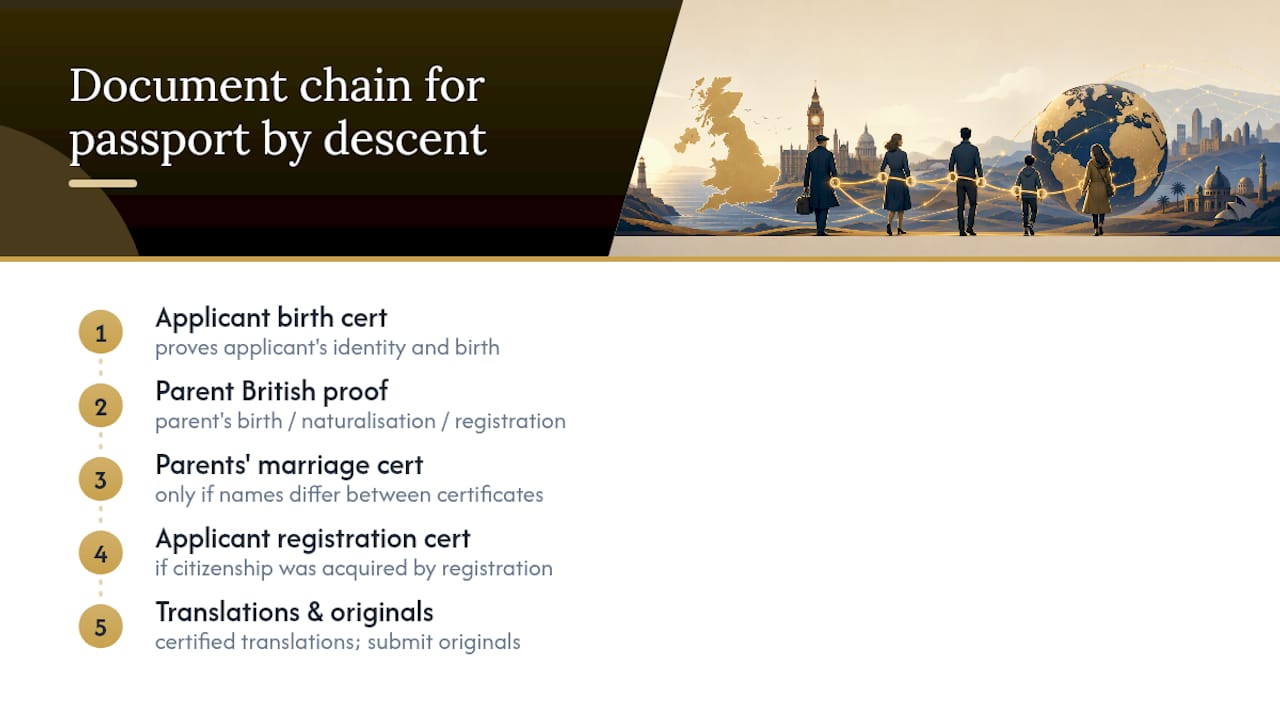
Passport applications for descent cases move slower than straightforward renewals because the caseworker is verifying a chain, not just confirming an existing record. Certified translations are required for any foreign-language document, and names must match across every certificate submitted. A maiden name on one certificate and a married name on another, without a marriage certificate bridging the two, is a common reason passport applications for descent claimants get delayed pending further evidence.
Keep original certificates, not photocopies, ready for submission, and hold onto certified copies for your own records once the originals are returned. Anyone who has already registered under one of the historic routes should treat their registration certificate as the single most important document in the file, since it is the primary evidence that the citizenship claim was formally recognized rather than simply assumed from family history.
What changes once you live outside the UK?
British citizens by descent living abroad keep full access to consular assistance from UK embassies and high commissions, the same as any other British citizen, regardless of whether their status came automatically or through registration. That includes emergency travel documents, support during a legal or medical crisis abroad, and standard consular services.
Voting rights work differently and catch people off guard. British citizens living overseas can register as overseas voters for UK parliamentary elections, but this depends on your own registration as a voter, not automatically on your citizenship type. Citizenship by descent doesn’t limit your voting rights any differently than citizenship otherwise than by descent does. The limitation that actually matters for people living abroad is the one already covered: your own ability to pass citizenship to a child born outside the UK, which is restricted precisely because your status is “by descent.”
This is where family planning intersects with paperwork in a very concrete way. If you’re a British citizen by descent living in the United States, Canada, or Australia and planning a family, it’s worth checking early whether your own citizenship transmits to a future child automatically or whether you’d need to plan around a UK birth or a specific registration route. Waiting until after a child is born abroad to discover the transmission limit applies is one of the most common regrets among people who assumed British citizenship simply passes down indefinitely.
Why the “just apply” advice misses the point
Most guidance on this topic treats citizenship by descent as a single yes-or-no question, and that framing sets people up to fail. The real work is in classification: figuring out exactly how your parent acquired their status, at what point in their life, and whether that acquisition route survived into the version of the law that applied when you were born.
The conventional advice, “check if your parent was British and apply,” skips the step that actually determines outcomes: proving the type of British citizenship your parent held. A parent born in the UK and a parent who is themselves British by descent are not equivalent starting points, even if both hold a British passport today. That distinction, not general eligibility, is where most rejected applications actually go wrong.
If there’s one priority worth acting on first, it’s this: identify your parent’s and grandparent’s exact acquisition route before you touch a form. Everything else, which section, which document, which registration path, follows from that single fact.
— Humans
Get help preparing your citizenship-by-descent application
Immigrationassistance runs on a fixed professional fee model rather than hourly billing, which means a complicated multi-generation descent case costs the same to prepare as a straightforward one: a flat £500 per application, covering evidence review, drafting, and submission support through the British citizenship service. That matters most for exactly the cases this article covers: pre1983 maternal-line claims, missing or foreign-issued certificates, and grandparent chains that need careful mapping against section 4C or sections 4F to 4I before anyone touches a form.
Start with a free consultation and have your key documents ready before that call: your own birth certificate, your parent’s birth or naturalization certificate, and your parents’ marriage certificate if applicable. If your case involves a British mother from before 1983, an unmarried parent, or records held overseas, that’s precisely when a second set of eyes on the evidence saves months of back and forth with the Home Office. Browse the full range of immigration services if your situation also touches residence status or a family member’s visa alongside the citizenship claim.
This article is general information, not a substitute for advice from a qualified lawyer. Consult a qualified legal professional about your own circumstances before acting on anything here.
Sources
FAQ
Can you claim British citizenship through ancestry?
Yes, but only through a parent or, in some cases, a grandparent’s status combined with your parent’s own registration, not through ancestry generally. The specific route depends on your birth date and exactly how your parent acquired citizenship, covered in the eligibility rules above.
How many generations back can you go for UK citizenship?
Automatic transmission generally works for one generation overseas: a UK-born or “otherwise than by descent” parent can pass citizenship to a child born abroad. A grandparent’s citizenship usually doesn’t reach you automatically unless your parent registered their own claim first, since the law limits automatic transmission beyond a single generation abroad.
Is it hard for an American to become a British citizen through a parent?
It isn’t hard so much as document-heavy. Americans with a British parent typically face the same evidence requirements as anyone else: birth certificates, proof of the parent’s exact citizenship category, and marriage certificates where relevant, and Immigrationassistance’s citizenship service is built around exactly that evidence-gathering step.
Can I claim British citizenship by descent if my mother was born before 1983?
Not automatically in most cases, because the pre1983 rules only recognized paternal-line transmission. You’ll likely need to register under section 4C using Form UKM, and successful registration gives you citizenship by descent, which comes with its own transmission limits for any children you have born outside the UK.
What does Immigrationassistance charge for a citizenship application?
Immigrationassistance’s British citizenship service runs at a fixed professional fee, detailed on the British citizenship page, separate from any Home Office application fee. Contact the team through a free consultation for the current figure and a document checklist specific to your case.